For wineries producing 5,000 to 50,000 bottles
Your wine label, legal in every EU country
Back label, QR e-label and printing. Checked before anything is printed.
- Regulation (EU) 2021/2117
- 6 languages
- Reply within 24 h

What changed on the bottle
8.12.2023
Every wine produced since this date needs ingredients and an energy value.
Reg. (EU) 2021/2117≈ 20 %
of wine QR codes checked in France led to an error or an incomplete page.
CLCV survey, 20251 country, 1 language
The e-label must be readable in the language of each country of sale.
Reg. (EU) 1169/2011
How it works
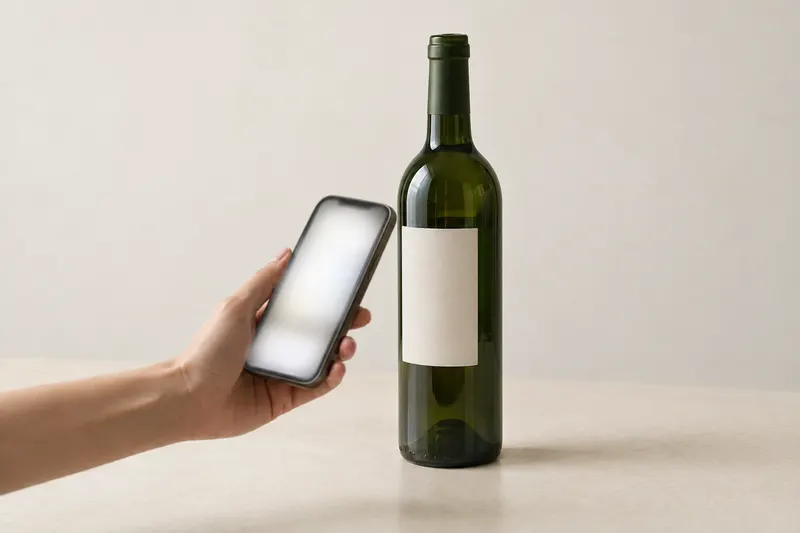
01A photo
Send a photo or PDF of your label and your countries of sale.
02Preparation
We write the back label and the e-label for each country.
03Verification
A specialist checks every mention before you approve the proof.
04Printing
Labels printed or files for your printer. The QR stays up to date.


The same back label, before and after
Before
- Allergen not stated
- No energy value
- QR without the word “ingredients”
- Characters too small
After
- Contains sulphites, printed
- E (100 ml) printed
- QR labelled “ingredients”
- x-height ≥ 1.2 mm
Rules country by country
Each page is written in the language of the country.


Clear prices, per winery
Label check
Free
- Your current label reviewed
- List of what is missing, per country
- Reply within 24 business hours
Back label + e-label
from €290 / year
excl. VAT
- Up to 5 wines (references)
- Back-label text per country of sale
- Specialist check before printing
- Hosted e-label page, no tracking
- Update at each vintage
Additional wines on quote.
Printing
On quote
- Format, paper and quantity of your choice
- Delivered to the winery
- Or print-ready files for your printer
Front label design
On quote
- Optional
- Front and back designed together
- Mandatory particulars placed from the start
No setup fee. No discount countdown. Swiss wineries: prices in CHF on request.
Questions from winemakers
Is the label check really free?
Yes. Send a photo or PDF of your current label and the countries where you sell. A specialist replies within 24 business hours with what is missing or at risk. You decide afterwards whether you want us to do the work.
Can you promise that my label is compliant?
No one can honestly promise that: the winery remains legally responsible for its labels, and the texts keep changing. What we do is check every mention against the published regulations of each country of sale before printing, and show you which text each mention comes from.
What happens to my QR codes if the rules or the vintage change?
The QR code points to a page we host. When a value or a rule changes, we update the page. The code already printed on your bottles keeps working.
Can you work with my usual printer?
Yes. We deliver a checked, print-ready PDF for your printer, or we have the labels printed and delivered to the winery if you prefer.
Do you only work with wine?
For now, yes. Labels for honey, spirits and jams are coming soon.
What changed on wine labels in the EU?
Since 8 December 2023, wines produced in the EU must declare a list of ingredients and a nutrition declaration (Regulation (EU) 2021/2117). The energy value and the allergens stay printed on the bottle. The full list and the nutrition table may sit behind a QR code, on a page with no marketing and no tracking.
The change amends article 119 of Regulation (EU) No 1308/2013, the text that has listed the compulsory particulars of wine for more than ten years. Wines produced before that date can be sold with their old labels until stocks run out. Every wine produced since then needs the new information.
In practice this adds three jobs to every bottling: writing an ingredients list with the right additive categories, calculating the energy value from the analysis, and publishing a QR page that respects strict conditions. Each new vintage brings new values. Each country of sale brings its own language and, in some cases, its own national mentions, such as the pregnancy pictogram in France or the health warnings that Ireland has scheduled.
Most wineries of our size have no quality department and no in-house designer. The printer prints the file it receives. The designer places the text he is given. The free e-label tool publishes the data you type in. Nobody reads the whole label against the texts, country by country, before the rolls are printed. That is the job we do.
Printed on the bottle or behind the QR code?
| Mention | On the printed label | Can go behind the QR |
|---|---|---|
| Energy value (kJ / kcal) | Yes | Full table: yes |
| Allergens (e.g. sulphites) | Yes | No, must stay printed |
| List of ingredients | Or via QR | Yes |
| Full nutrition declaration | Or via QR | Yes |
| Alcohol, volume, category, origin | Yes | No |
| Marketing, tracking, cookies | — | Never on the e-label page |
Under Regulation (EU) 2021/2117, for wines produced from 8 December 2023.
Which wineries is the service built for?
Family estates and small cooperatives that bottle between 5,000 and 50,000 bottles, make four to twelve wines and sell in at least one EU country other than their own, directly, through an importer or online.
You export inside the EU
An Italian estate selling in Germany, a Portuguese producer with a Belgian importer: each market needs its allergen wording and an e-label in its language.
You bottle several wines
Six wines and two vintages a year means a dozen back labels and e-label pages to keep right. We keep them up to date for you.
You are outside the EU
Swiss, British or American wineries that ship to the EU must follow EU rules for those bottles. See what changes.
Why not just use a free e-label generator?
A free generator is a good tool if you are sure of your data. It publishes the page from what you type; it does not check the ingredients list, the allergen wording for each country, the size of the characters or the rest of the back label. We do the whole label and keep it right at every vintage.
We list the other options honestly below, with their public prices. Several of them are excellent at one part of the job. If one of them covers everything you need, use it.
How the options compare
Public prices noted in November. Each tool does part of the job well; none of them writes and checks the back label for you.
| Option | Price | Writes the back label | Checked before print | Hosted e-label | Printing |
|---|---|---|---|---|---|
| E-label platforms (U-Label by Scantrust) | €230 to €1,500 / year | No, you enter the data | No | Yes | No |
| e-label.eu | Free (3 labels) to €130 / year | No, you enter the data | No | Yes | No |
| Online label printers | ≈ €0.05 to €0.30 per label | No | No | No | Yes |
| Templates and freelance designers | Free to €1,500 | Layout only | No | No | No |
| WineLex | from €290 / year (5 wines) | Yes | Yes, by a specialist | Yes, every vintage | Yes, on quote |
Sources: published price pages of each provider; printer prices from public configurators.
Where to start on this site
- EU wine labelling requirements: the complete list of mandatory particulars, with the article that requires each one.
- Wine back label: what we write, how we check it, what it costs.
- Wine e-label: the QR page, what it must and must not contain.
- Rules country by country: Italy, Germany, Austria, France, Spain, Portugal, Switzerland, Ireland.
- Energy value calculator: the kJ and kcal line for your label, free.
- Articles: calories, sulphites, egg and milk fining, ingredients, vegan labels.
Free check of your label
Four fields are enough. A specialist replies within 24 business hours.
WineLex prepares the back label and the e-label of your wine for every EU country where you sell it, checked by a specialist before printing. We host the QR-code page in each language, update it at every vintage and deliver the labels printed.
Sources
Selection criteria: we cite official texts first (EUR-Lex, national law portals), then named surveys with their publisher.